







Crypto Client Onboarding & Payment-Terms Kit
Most payment problems are onboarding problems that surface at payment time. In one 2025 industry survey, 85% of freelancers said their invoices are paid late at least some of the time, and only 15% said they are always paid on time. You cannot fix that with a better invoice: by the time an invoice exists, the terms have already been set — usually by silence. This kit is the written version of that conversation, and it runs in about forty minutes per new client.
What is inside
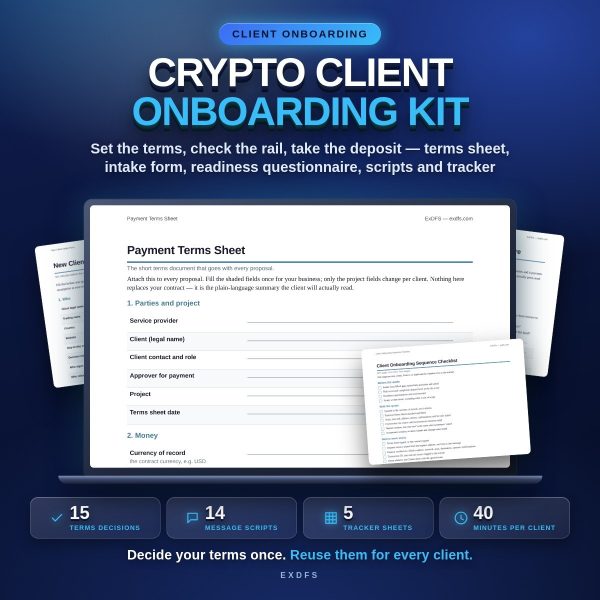
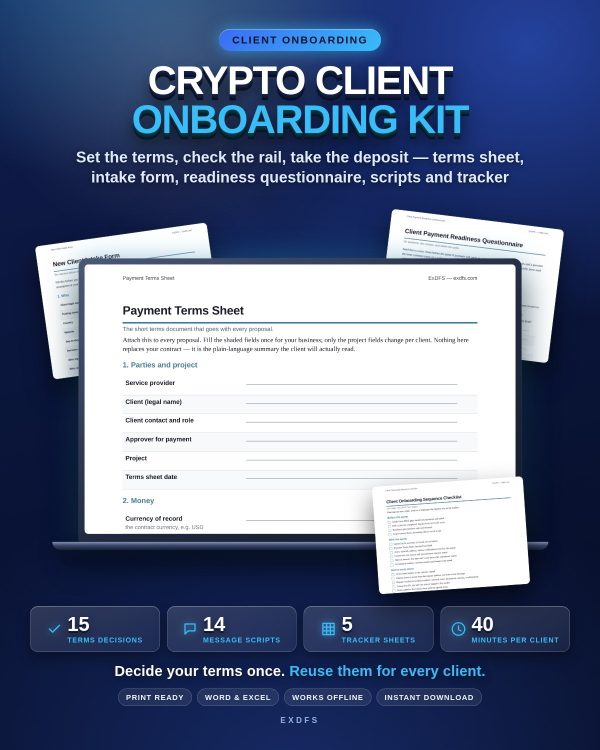
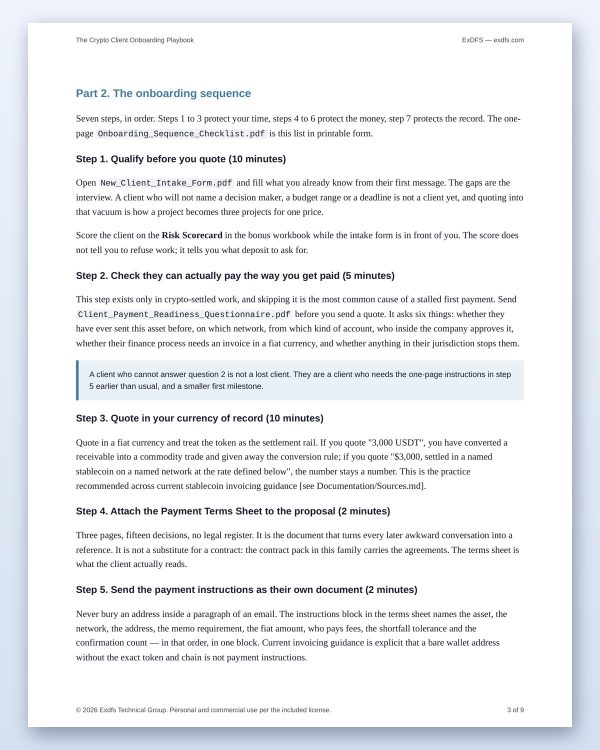
- The playbook. Why onboarding is a payment control, the seven-step sequence, the fifteen decisions your terms have to settle, the six conversations that decide whether the terms hold, and the records that survive the project.
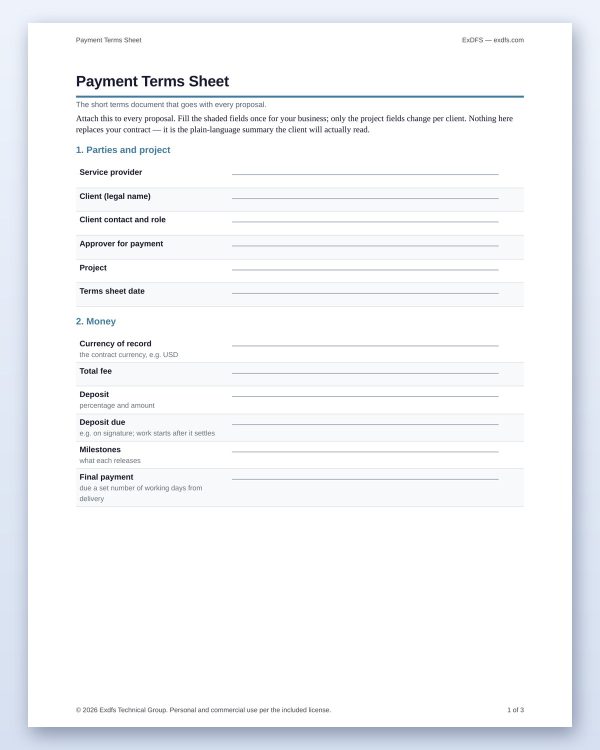
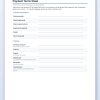
- Payment Terms Sheet. Three pages, attached to every proposal: parties, money, settlement rail, what happens when something is off, acceptance, signatures.
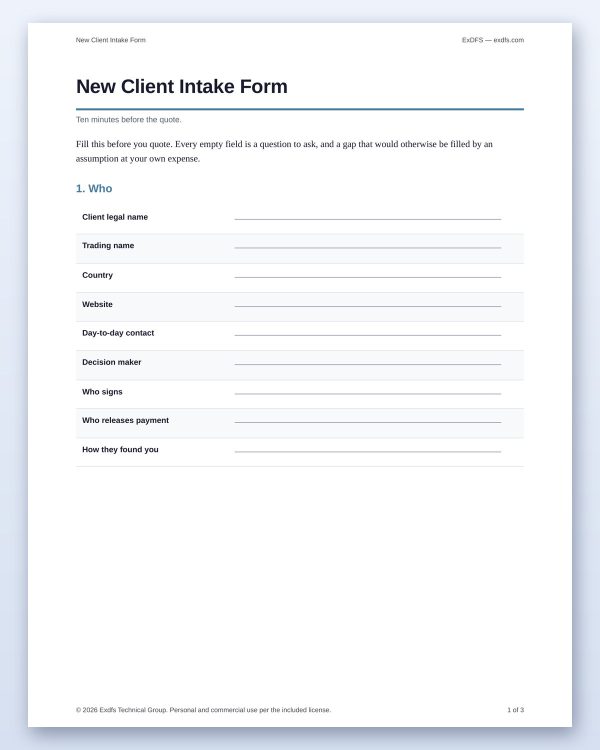
- New Client Intake Form. Ten minutes before you quote. Every blank field is a question to ask instead of an assumption to pay for later.
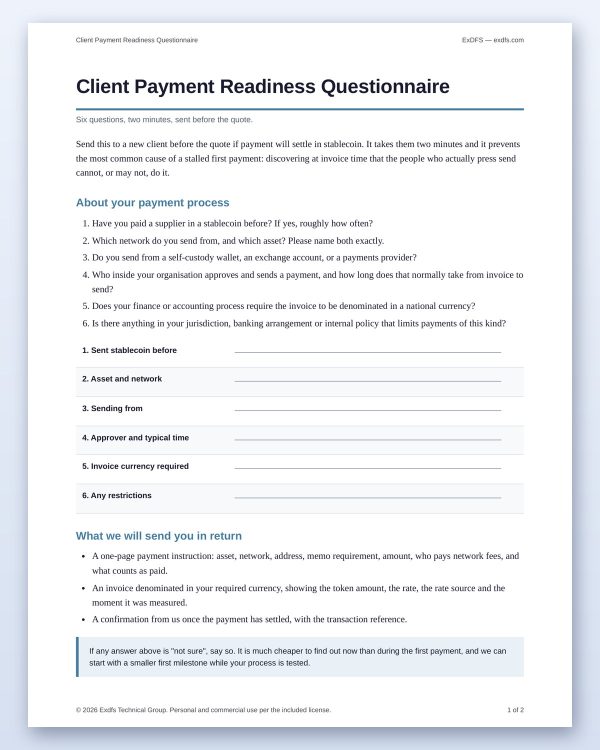
- Client Payment Readiness Questionnaire. Six questions sent before the quote, because discovering at invoice time that their finance team cannot send stablecoin is the most common cause of a stalled first payment.
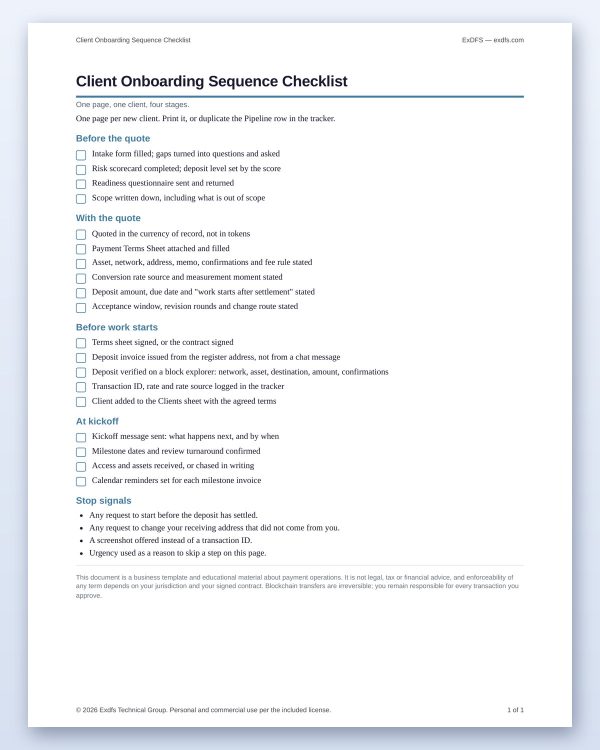
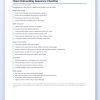
- Onboarding Sequence Checklist. One printable page per client, four stages, plus the stop signals.
- Fourteen message scripts. First reply, stating the deposit as policy, holding the line when asked to start early, payment instructions, asking for a transaction ID, short payment, overpayment and refund requests, address-change requests, scope change, the first late chase, and the polite decline.
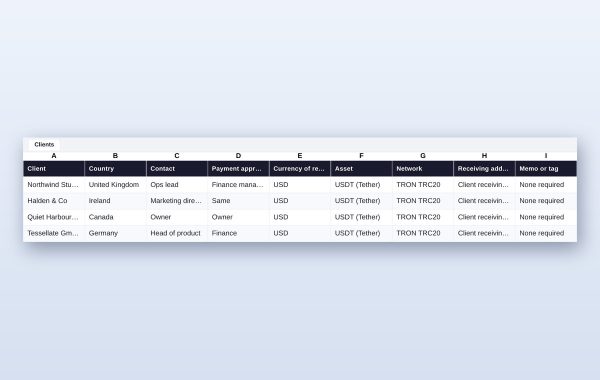
- Client Onboarding Tracker (spreadsheet, five sheets). Agreed terms per client, a pipeline that counts your completed onboarding steps and the days from enquiry to deposit, and a payments log that calculates expected units, the difference, your tolerance check and whether your evidence is complete.
- Two bonuses: a clause library with ready wordings for each decision and a table telling you which option to choose, and a risk scorecard whose sixteen weighted questions turn a gut feeling into a deposit percentage.
The part no ordinary onboarding packet has
A normal welcome packet never asks which network, whether a memo is required, who pays the transfer fee, which rate source applies and at what moment, how many units of shortfall still count as paid, or how many confirmations mean paid. On a rail where transfers are final, those are the questions that decide whether you are paid or merely told you were paid.
Stated honestly
These are business templates and educational material, not legal, tax or financial advice, and no wording has been reviewed for your jurisdiction — late-charge terms in particular differ by country, so the clause library gives you a charge-free alternative with real teeth. The tracker is a manual record: nothing here detects a payment, touches a wallet or installs software.
One-time purchase. No account, no subscription. Works offline in software you already have.












Reviews
There are no reviews yet.